 admin1
 Basbousa is a traditional sweet cake widely enjoyed across Egypt, the Levant, and the wider Middle East. It is made primarily from semolina, sugar, and yogurt, then soaked in fragrant sugar syrup often flavored with rose water or orange blossom water. Basbousa is known for its soft, slightly grainy texture, golden crust, and moist sweetness. It is commonly served during Ramadan, family gatherings, and celebrations, often alongside tea or Arabic coffee.
This is a detailed large-family recipe serving about 10 to 12 people.
Ingredients for the cake include 2 cups fine semolina, 1 cup desiccated coconut (optional but traditional in many versions), 1 cup plain yogurt, 1 cup sugar, 1/2 cup melted butter or ghee, 1 teaspoon baking powder, 1 teaspoon vanilla extract, and a pinch of salt. For the topping you will need whole almonds or halved almonds. For the syrup you need 2 cups sugar, 1 cup water, 1 teaspoon lemon juice, and 1 tablespoon rose water or orange blossom water.
Start by preparing the sugar syrup so it can cool completely before the cake is baked. In a saucepan combine sugar and water and bring to a boil while stirring until the sugar dissolves. Add lemon juice and reduce heat. Let it simmer for about 10 minutes until slightly thickened but still light and pourable. Remove from heat and add rose water or orange blossom water. Set aside to cool fully.
In a large mixing bowl combine semolina, sugar, baking powder, salt, and coconut if using. Mix well so all dry ingredients are evenly distributed. Add melted butter or ghee and mix thoroughly with your hands or a spoon until the mixture becomes sandy and evenly coated. This step helps create the signature crumbly-yet-soft texture of basbousa.
Add yogurt and vanilla extract to the mixture. Stir until everything is fully combined into a thick batter. The texture should be soft but not runny, similar to a dense cake mixture. If it feels too dry, you can add a small spoon of yogurt. If it feels too wet, add a little more semolina.
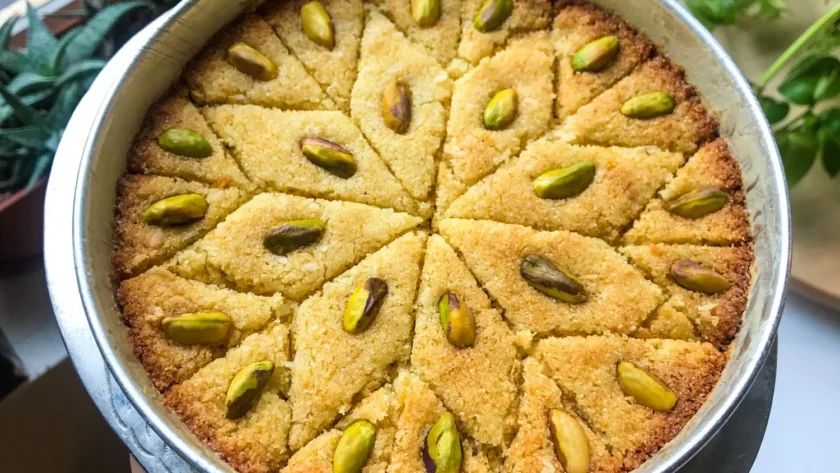
Grease a medium or large baking tray generously with butter or ghee. Pour the batter into the tray and spread it evenly using a spatula. Smooth the surface so it is level. Using a knife, lightly score the surface into diamond or square shapes without cutting all the way through. This helps with portioning after baking.
Place an almond or half almond on the center of each piece as decoration. Let the batter rest for about 10 to 15 minutes so the semolina absorbs moisture and the texture becomes more cohesive.
Preheat the oven to 180°C and bake the basbousa for about 30 to 40 minutes or until the top turns golden brown. The edges should be slightly deeper in color, which indicates proper caramelization.
Once baked, remove the tray from the oven while the basbousa is still hot. Immediately pour the cooled sugar syrup evenly over the entire surface. The cake will absorb the syrup gradually, becoming moist and fragrant. Allow it to rest for at least 30 minutes so the syrup fully penetrates the cake.
After resting, cut along the scored lines and gently lift the pieces out. The texture should be soft, moist, and slightly grainy with a sweet aromatic syrup coating.
Basbousa is traditionally served at room temperature and pairs beautifully with Arabic coffee or black tea. Some variations include adding cream filling, coconut-heavy versions, or even pistachios on top. Another popular variation is “basbousa with cream” where a layer of ashta is added in the middle before baking.
The key to perfect basbousa is balancing moisture and syrup absorption. If the syrup is too hot or too thick, it can make the cake overly dense. If the cake is too dry, it will not absorb enough syrup. When done correctly, it becomes soft, fragrant, and melts gently in the mouth.
This recipe produces a rich, golden basbousa with a tender semolina crumb and floral syrup, making it one of the most beloved desserts in Middle Eastern cuisine.