 admin1
 Mango Cheesecake is a rich, creamy, chilled dessert that combines a buttery biscuit base, a smooth cream cheese filling, and a bright mango topping or puree layer. It is different from baked cheesecakes in some versions, but here I’ll describe a detailed no-bake style that is commonly made at home because it is easier, more stable in warm climates, and gives a soft, mousse-like texture with a firm set.
To begin, you first prepare the base because it needs time to chill and firm up. Take about 200 to 250 grams of digestive biscuits or graham crackers and crush them into very fine crumbs. You can do this by placing them in a food processor or putting them in a zip bag and rolling with a rolling pin until they become sand-like in texture. The finer the crumbs, the more stable and even your base will be. Melt about 100 grams of unsalted butter and mix it thoroughly with the biscuit crumbs. The mixture should look like wet sand and hold shape when pressed between your fingers.
Now take a springform pan or a removable-bottom cake pan. Pour the biscuit mixture into it and press it down firmly using the back of a spoon or a flat glass. Pressing firmly is important because a loose base will crumble when you cut the cheesecake later. Once the base is evenly packed, place the pan in the refrigerator for at least 30 to 45 minutes so the butter solidifies and the crust becomes firm.
While the base is chilling, prepare the mango layer that will later go on top or be swirled into the filling. Take 2 to 3 large ripe mangoes, preferably sweet varieties like Sindhri or Chaunsa. Peel and remove the flesh, then blend it into a smooth puree. You should get around 1.5 to 2 cups of thick mango pulp. Taste it and if needed add 2 to 3 tablespoons of sugar, but avoid over-sweetening because the cheesecake filling is already rich. Keep this puree aside, preferably chilled.
Now move to the cheesecake filling, which is the heart of the dessert. Take 400 grams of cream cheese at room temperature. It is important that the cream cheese is soft because cold cream cheese will form lumps and not blend smoothly. Beat it in a large bowl until it becomes creamy and smooth. Then add about 1 cup of powdered sugar gradually while continuing to beat. The mixture should become light and silky.
Next, add 1 teaspoon vanilla essence for aroma and 1 to 2 tablespoons of lemon juice. The lemon juice does not make it sour; instead, it balances the sweetness and enhances the overall flavor. Beat everything again until fully combined. In a separate bowl, whip 1.5 cups of chilled heavy cream until soft peaks form. The cream should be airy but not overwhipped. Once ready, gently fold this whipped cream into the cream cheese mixture using a spatula. Folding slowly is important to keep the mixture light and fluffy.
At this stage, you can optionally add a stabilizer if you want a firmer cheesecake that slices cleanly. Dissolve 1 tablespoon of gelatin in 3 to 4 tablespoons of warm water, let it cool slightly, and then mix it into the filling while stirring continuously. If you prefer an eggless and gelatin-free version, you can skip this step, but the cheesecake will be slightly softer.
Now bring back the mango puree. You have two options depending on the style you want. For a fully mango-flavored cheesecake, fold the mango puree directly into the cream cheese mixture until it becomes uniformly pale yellow and smooth. For a layered or swirl cheesecake, keep the filling plain and use mango puree separately on top.
Pour the prepared filling over the chilled biscuit base. Smooth the surface using a spatula so it is even. If you are doing a swirl effect, pour half the plain filling first, add spoonfuls of mango puree on top, and use a toothpick or knife to gently swirl it into patterns. Then pour the remaining filling and repeat lightly on top.
Once assembled, tap the pan gently on the counter to remove air bubbles. Cover it with plastic wrap or foil and refrigerate for at least 8 to 10 hours, preferably overnight. Cheesecake needs slow chilling time to set properly and develop its creamy texture. Do not freeze it unless you specifically want a frozen cheesecake texture, because freezing can change the creaminess.
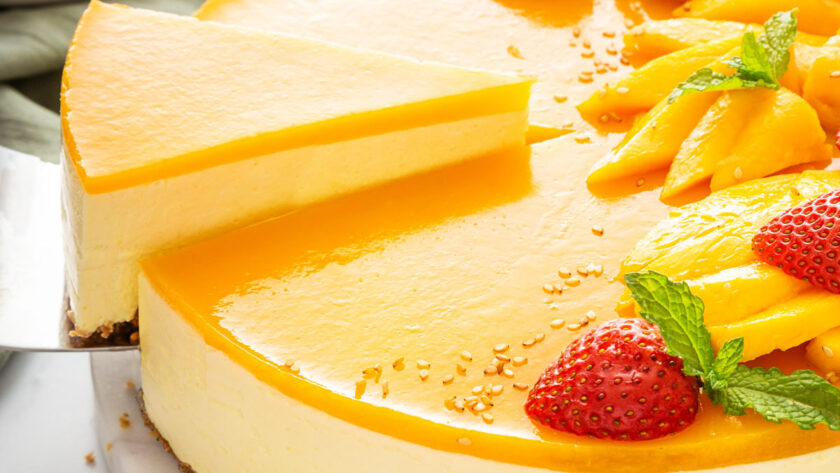
After it is fully set, prepare the topping layer if desired. Heat about half a cup of mango puree with a teaspoon of sugar and a few drops of lemon juice for a glossy glaze, then cool it completely before spreading on top of the cheesecake. This creates a shiny mango mirror layer that enhances both flavor and appearance.
When ready to serve, carefully release the springform pan and slice with a sharp knife dipped in hot water for clean cuts. The texture should be smooth, creamy, and slightly dense but still soft, with the biscuit base providing a crunchy contrast. The mango flavor should feel fresh and tropical, balancing the richness of cream cheese and whipped cream.
For variations, you can create a baked version by using eggs and baking the cream cheese filling at a low temperature, but that requires more precision. Another variation is a mango cheesecake jar dessert where layers of biscuit crumbs, filling, and mango puree are repeated in small glasses for easy serving. You can also add white chocolate into the filling for a sweeter, more decadent version.
A well-made mango cheesecake should feel luxurious but not heavy, creamy but not runny, and fruity but not overpowering. The success depends mainly on three things: properly whipped cream, smooth cream cheese without lumps, and enough chilling time for the structure to set.