 admin1
 Mango Kulfi is a rich, traditional South Asian frozen dessert that blends the creamy density of slow-cooked milk with the tropical sweetness of ripe mangoes, and making it at home in a very detailed, long-form way helps you understand not just the recipe but the technique behind its authentic texture and flavor. To begin, the most important base for mango kulfi is full-fat milk, ideally 2 to 2.5 liters, because kulfi depends on milk reduction rather than added cream alone. Pour the milk into a heavy-bottomed wide pan so evaporation happens evenly, and place it on medium flame. Bring it to a gentle boil while stirring continuously in the beginning to prevent sticking at the bottom. Once it starts boiling, lower the flame slightly and let it simmer slowly. The key process here is reduction, where the water content evaporates and the milk solids become concentrated, giving kulfi its signature dense texture.
As the milk continues to simmer, keep stirring every few minutes, scraping the sides of the pan and mixing the layer of cream (malai) that forms on top back into the milk. This step is very important because it enriches the mixture naturally without needing artificial thickening. Over time, the milk will reduce to almost half or even one-third of its original volume. This can take 45 minutes to over an hour depending on flame and pan width. At this stage, you can add half a cup of sugar or adjust sweetness according to taste, stirring until fully dissolved. You may also add a pinch of cardamom powder, which gives kulfi its classic aroma, and optionally a few strands of saffron soaked in warm milk for deeper flavor and color.
Once the milk has thickened significantly and turned slightly pale cream in color, continue simmering for a few more minutes until it reaches a rabri-like consistency. Turn off the heat and allow the mixture to cool completely at room temperature. This cooling step is essential because adding mango pulp to hot milk can cause curdling or separation. While the mixture is cooling, prepare the mango component. Choose ripe, sweet, non-fibrous mangoes such as Chaunsa, Sindhri, or Alphonso if available. Peel and cut them, then blend the pulp until smooth. You should aim for around 1.5 to 2 cups of thick mango puree depending on how strong you want the mango flavor to be.
When the milk mixture is fully cooled, whisk it well to smooth out any skin or lumps that may have formed. Then gently fold in the mango puree, mixing slowly but thoroughly so the base becomes uniform. At this stage, you can also add chopped nuts such as pistachios, almonds, or cashews, lightly crushed, to give texture and a traditional kulfi feel. Some people also add a few drops of rose water or kewra essence, but these should be used sparingly so they do not overpower the mango flavor.
Now prepare molds for freezing. Traditionally, kulfi is set in small earthen pots called kulhads, but modern molds, steel cups, or silicone molds work perfectly. Pour the mango kulfi mixture into the molds, leaving a little space at the top because the mixture will expand slightly during freezing. Cover each mold tightly with foil or a lid to prevent ice crystals from forming due to air exposure. Place them in the freezer and let them set for at least 6 to 8 hours, though overnight freezing gives the best firmness and texture.
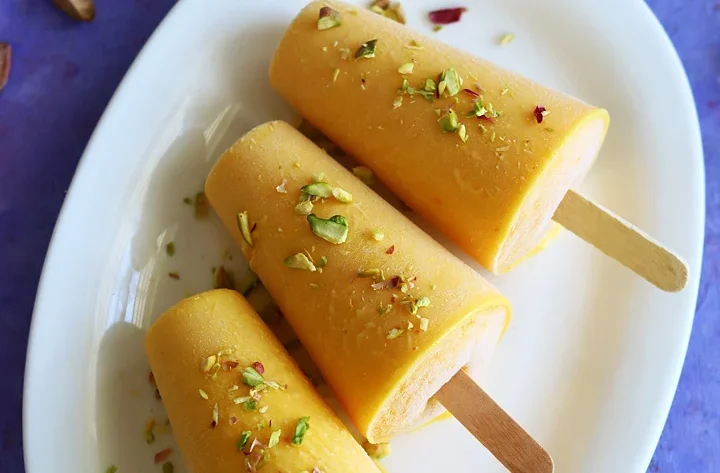
Once fully frozen, removing kulfi can be done by briefly dipping the mold in lukewarm water for a few seconds, which loosens it without melting the dessert. Gently slide it out or insert a stick if you are making stick kulfi. The texture should be dense, creamy, and slightly grainy in the traditional way, not airy like ice cream. When you cut into it or bite it, it should melt slowly in the mouth while releasing rich mango flavor followed by creamy milk and aromatic cardamom notes.
For variations, you can enrich the recipe by adding condensed milk during the milk reduction stage for extra sweetness and creaminess, or replace part of the milk with evaporated milk for a faster thickening process. Another variation includes layering mango puree separately so you get a marbled effect inside the kulfi. Some also add small mango chunks at the end for a fruitier bite. If you want a more luxurious version, a tablespoon of khoya (mawa) can be added into the reduced milk for deeper richness.
The final result should be a perfectly balanced dessert where the natural tartness and sweetness of mango blend with the slow-cooked dairy base, creating a frozen treat that is dense, aromatic, and deeply satisfying. Making it slowly and patiently is what gives mango kulfi its authentic character, because rushing the milk reduction or freezing stage will change the texture significantly.